
Subscribe to continue reading
Subscribe to get access to the rest of this post and other subscriber-only content.
JJLBS LLC Remote Closing and Notary Services
Remote Loan Signing & Notary Services
Subscribe to get access to the rest of this post and other subscriber-only content.
Subscribe to get access to the rest of this post and other subscriber-only content.
Access to Notarial Services Does Not Necessarily End at the Facility Door
JJLBS Remote Closing and Notary Services
Notary Education & Professional Practice Newsletter
August 2026
INTRODUCTION
Incarceration can substantially restrict a person’s movement and access to ordinary professional services, but it does not automatically eliminate the need—or ability—to execute important legal, financial, family, business, and personal documents.
An incarcerated individual may need a notary for a power of attorney, affidavit, sworn statement, property document, authorization, estate-planning instrument, court-related document, or other transaction requiring a notarized signature.
Providing notarial services in a jail, prison, detention center, or correctional institution, however, presents circumstances that are considerably different from an ordinary office appointment.
The notary must balance several separate requirements:
Notarial law + facility security procedures + signer identification + voluntariness + document restrictions + professional neutrality.
The result is a specialized form of general notary work that requires preparation before the appointment begins.
WHY WOULD AN INCARCERATED PERSON NEED A NOTARY?
Incarceration does not stop everyday legal and financial affairs.
An incarcerated signer might need to execute documents concerning:
The notary’s function remains limited.
A notary generally verifies matters associated with the particular notarial act—such as identity, personal appearance, acknowledgment, or administration of an oath or affirmation. The notary does not automatically verify that every factual statement contained within the document is true.
THE FIRST QUESTION: WILL THE FACILITY ALLOW THE NOTARIZATION?
Before scheduling an appointment, determine the rules of the particular correctional institution.
A state notary commission does not override a jail or prison’s legitimate security procedures.
Facilities may regulate:
Some institutions may already provide notarial services internally.
Others may permit an outside commissioned notary to enter under specified conditions.
Never assume that a notary appointment can be conducted simply because the signer, family member, attorney, or another interested person requested it.
Facility approval should be addressed before traveling to the institution.
IDENTIFICATION CAN BECOME THE CENTRAL ISSUE
One of the most significant challenges when notarizing for an incarcerated signer is satisfactory identification.
A signer may not possess a driver’s license, passport, or other identification normally presented during a conventional appointment.
The notary must determine what identification methods are permitted under the law governing the notarial act.
Depending upon the jurisdiction, permissible identification procedures may include satisfactory documentary identification, personal knowledge, credible witnesses, or another statutorily authorized method.
A correctional institution’s inmate identification system may also become relevant where state law specifically permits or recognizes such identification.
The crucial distinction is this:
Facility identification and legally satisfactory evidence of identity are not necessarily the same thing.
The fact that correctional officers know who an inmate is does not, standing alone, authorize a notary to disregard the identification requirements imposed by applicable notary law.
Before accepting an inmate identification card, booking record, prison identification number, credible witness, or alternative identification procedure, the notary should determine whether that method is legally permissible in the commissioning jurisdiction.
PERSONAL APPEARANCE STILL MATTERS
Traditional notarization ordinarily requires the signer to personally appear before the notary.
Being separated by institutional security procedures does not necessarily eliminate that requirement.
The notary should be able to interact with the signer sufficiently to perform the required notarial act.
For an acknowledgment, for example, the signer ordinarily must acknowledge execution of the document as required by applicable law.
For a jurat or verification on oath or affirmation, the notary must administer the required oath or affirmation and witness the signature when required by governing law.
The precise requirements depend upon the notarial act and applicable state law.
WILLINGNESS AND AWARENESS REQUIRE SPECIAL ATTENTION
Correctional settings can involve unusual pressures.
A document may have been prepared by:
The notary remains an impartial official.
The notary should be attentive to indications that the signer is being coerced, threatened, improperly pressured, or does not understand the nature of the transaction sufficiently to participate in the requested notarial act.
If the circumstances prevent the notary from obtaining the legally required acknowledgment, oath, affirmation, signature, identification, or personal interaction, the notarization should not simply proceed for convenience.
THE NOTARY IS NOT THE SIGNER’S ATTORNEY
Incarcerated individuals may understandably have questions about documents affecting their rights.
Those questions can create a significant boundary issue.
A non-attorney notary should not provide unauthorized legal advice merely because the signer has limited access to outside resources.
For example, a notary should be cautious about answering questions such as:
“Should I sign this power of attorney?”
“Will signing this waive my rights?”
“Which document do I need to transfer my property?”
“What should I write in this affidavit?”
“Will this document help my criminal case?”
Those are potentially legal questions—not merely notarial questions.
A notary may generally explain the notarial procedure within the scope permitted by law, but should not select legal documents, determine legal rights, draft legal instruments when unauthorized to do so, or advise the signer about the legal consequences of signing.
DOCUMENT COMPLETENESS REMAINS IMPORTANT
A correctional setting should not cause ordinary notarial safeguards to disappear.
Before performing the notarization, the notary should examine the document sufficiently to determine whether the requested notarial act can lawfully be completed.
Potential problems include:
A notary should not improvise merely because arranging another correctional-facility appointment would be inconvenient.
ACKNOWLEDGMENT VS. JURAT: KNOW THE DIFFERENCE
Two commonly encountered notarial acts are acknowledgments and jurats or verifications upon oath or affirmation.
Acknowledgment
Generally, an acknowledgment involves the signer personally appearing before the notary, being properly identified, and acknowledging execution of the document as required by applicable law.
Depending upon state law and the particular document, the signature may have been made before the appointment.
Jurat / Verification on Oath or Affirmation
A jurat generally involves the signer personally appearing, taking an oath or affirmation regarding the truthfulness of the statement, and signing in the notary’s presence when required by applicable law.
The notary must administer the oath or affirmation.
These acts are not interchangeable.
If the document does not contain a certificate or the appropriate notarial act is unclear, a non-attorney notary generally should not make the legal decision for the signer. The signer may need instructions from the document recipient, an attorney, or another legally authorized source.
THE NOTARY JOURNAL
A correctional-facility notarization should be documented in the notary’s journal whenever a journal is required by state law—and maintaining a journal may be a valuable professional practice even in jurisdictions where it is not universally mandated.
Subject to applicable law, a journal entry may document information such as:
The journal should not become an unauthorized repository for confidential information from the underlying document.
Correctional security procedures also matter. A notary planning to bring a journal into a secure institution should determine beforehand whether the journal will be permitted.
REMOTE ONLINE NOTARIZATION AND INCARCERATED SIGNERS
Remote Online Notarization, commonly called RON, introduces another possibility—but also another layer of complexity.
A remote notarization generally uses approved or legally compliant audiovisual technology so that the signer and notary can communicate remotely rather than being physically located in the same room.
For an incarcerated signer, this can potentially eliminate the need for an outside notary to enter the secure portion of a correctional institution.
But the existence of RON technology does not mean that every incarcerated signer can use it.
Several independent questions must be answered:
1. Does the notary’s commissioning state authorize the requested remote notarial act?
2. Is the notary properly authorized or registered to perform remote notarizations where required?
3. Can the signer satisfy the legally required remote identity-proofing procedures?
4. Does the correctional institution permit the required audiovisual communication?
5. Does the institution permit the signer to access the necessary hardware, software, email, identification credentials, and electronic documents?
6. Can the transaction satisfy applicable electronic-signature and recordkeeping requirements?
7. Is the particular document legally eligible for remote notarization?
A facility may restrict internet access, personal email, smartphones, webcams, electronic signatures, document uploads, or outside videoconferencing platforms.
Accordingly, RON eligibility under state notary law and technological access inside the institution are two separate questions.
Both must be resolved.
VIRGINIA REMOTE ONLINE NOTARIES
Virginia is significant in the development of electronic and remote notarization.
For a Virginia electronic notary considering an incarcerated signer, the notary should evaluate the transaction under current Virginia electronic-notary requirements, including the rules governing the notary’s location, the signer’s identity, audiovisual communication, electronic records, and any required retention or recording procedures.
The correctional institution must separately permit the signer to participate in the necessary electronic process.
A Virginia RON commission does not compel a correctional institution in Virginia—or another jurisdiction—to provide an inmate with a computer, internet connection, email account, identification technology, or access to a particular RON platform.
Coordination with the institution is therefore essential.
BEFORE ACCEPTING AN INCARCERATED-SIGNER ASSIGNMENT
A prudent notary should establish the logistics before accepting payment or traveling to the institution.
Consider confirming:
NEVER GUARANTEE THE NOTARIZATION
A professional notary can confirm an appointment.
The notary should be cautious about guaranteeing in advance that the document will be notarized.
Successful completion may depend upon conditions that cannot be conclusively established until the transaction occurs, including satisfactory identification, personal appearance, willingness, awareness, document completeness, the requested notarial act, and facility cooperation.
A more appropriate professional position is:
The appointment is for the purpose of attempting to perform the requested lawful notarial act, subject to satisfaction of all applicable notarial and facility requirements.
WHEN THE NOTARY MAY NEED TO STOP
Subject to applicable law, circumstances preventing completion can include:
The notary’s responsibility is not to make every transaction succeed.
The responsibility is to perform only those notarial acts that can be completed lawfully and properly.
A SPECIALIZED PUBLIC SERVICE
Notary services for incarcerated individuals occupy an important intersection between public service and procedural compliance.
The signer may be physically confined while still needing to manage property, family affairs, financial obligations, litigation, estate planning, business matters, and other legal relationships occurring outside the institution.
A properly performed notarization can help facilitate those transactions.
But incarcerated-signer assignments demand preparation.
The professional notary should approach each assignment by asking four fundamental questions:
Is the notarization legally permitted?
Can the signer be satisfactorily identified?
Can every element of the requested notarial act actually be performed?
Will the correctional institution permit the procedures necessary to accomplish it?
When the answer to all four is yes, notarial services can provide an important connection between an incarcerated individual and legal or commercial affairs beyond the correctional facility.
PROFESSIONAL PRACTICE NOTE
Notary laws vary substantially among states, and correctional institutions maintain their own security and visitation policies. Remote-online-notarization laws likewise differ by jurisdiction and may contain special requirements concerning the location of the notary, location of the signer, identity proofing, audiovisual communication, electronic records, and retention.
Notaries should verify the current law of their commissioning jurisdiction and the rules of the particular correctional institution before accepting an incarcerated-signer assignment.
JJLBS Remote Closing and Notary Services
Professional Notary Education • General Notary Work • Remote Online Notarization
Educational Disclaimer: This newsletter is provided for general educational and informational purposes. It is not legal advice and does not create an attorney-client relationship. Notaries should consult the statutes, regulations, commissioning authority guidance, and correctional-facility procedures applicable to each transaction.
Subscribe to get access to the rest of this post and other subscriber-only content.
Subscribe to get access to the rest of this post and other subscriber-only content.
When people think about notary services, they often picture real estate closings, powers of attorney, or estate planning documents. However, one of the most important—and often misunderstood—areas of notarization involves serving individuals who are incarcerated.
Whether an inmate needs to execute a power of attorney, sign legal documents, complete an affidavit, or handle personal business matters, notarization remains an important legal safeguard. At the same time, correctional facilities operate under strict security procedures that affect how these notarizations are performed.
Understanding the process before scheduling an appointment can help avoid delays and ensure a smooth experience for everyone involved.
Being incarcerated does not prevent someone from having documents notarized. In many situations, inmates may need a notary to assist with documents involving:
Each correctional facility has its own procedures, so preparation is essential before arranging a notarial appointment.
A guide to notarizing for prison inmates | NNA.pdf
One of the most important aspects of any notarization is verifying the signer’s identity.
Because incarcerated individuals often surrender their driver’s licenses and other common forms of identification upon entering a correctional facility, identity verification can become one of the biggest challenges.
The National Notary Association recommends confirming before the appointment what form of identification the facility will permit and whether the inmate has access to an acceptable credential. Some states authorize specific inmate identification cards or other approved methods, while facilities may have additional restrictions.
A guide to notarizing for prison inmates | NNA.pdf
Unlike a typical office appointment, correctional facilities maintain strict security protocols.
Visitors—including notaries—may encounter requirements such as:
Contacting the facility before the appointment can help identify these requirements and reduce unexpected delays.
A guide to notarizing for prison inmates | NNA.pdf
Notarial appointments inside correctional facilities may differ significantly from traditional appointments.
Depending on the institution:
These procedures are designed to maintain institutional safety while allowing lawful notarial services to be provided.
A guide to notarizing for prison inmates | NNA.pdf
Many states require notaries to maintain a notarial journal.
When an inmate signs the journal, the notary should take reasonable steps to protect the privacy of previous journal entries. The National Notary Association recommends using a privacy guard or similar method to prevent unrelated entries from being viewed during the signing process.
A guide to notarizing for prison inmates | NNA.pdf
Although correctional facilities present unique circumstances, the fundamental requirements for notarization do not change.
A notary should never:
The National Notary Association emphasizes that every notarization must comply with the notary laws of the commissioning state, regardless of where the signer is located.
A guide to notarizing for prison inmates | NNA.pdf
At JJLBS Remote Closing Services, we understand that every notarization deserves professionalism, impartiality, and careful attention to legal requirements.
While Virginia Remote Online Notarization (RON) generally requires identity verification through approved technology and the signer’s ability to participate in a live online session, some incarcerated individuals may not have access to the necessary technology or approved identification methods. Whether a remote notarization is possible depends on Virginia law, the correctional facility’s policies, and the signer’s circumstances.
If you are seeking notarization for an incarcerated family member, friend, or client, we encourage you to contact us before scheduling an appointment. We can discuss the type of document involved, explain the general requirements for a Virginia notarial act, and help determine whether a remote notarization may be feasible or whether another lawful option should be explored.
If you have questions about notarizing documents for an incarcerated individual or would like to discuss your specific situation, JJLBS Remote Closing Services is here to help you understand the notarization process while ensuring every appointment is conducted in accordance with Virginia law and applicable correctional facility requirements.
A guide to notarizing for prison inmates | NNA.pdf
Published by JJLBS Remote Closing Services
One of the most common questions we receive from clients across the country is:
“I live in another state. Shouldn’t I use my state’s notarial certificate?”
The answer is generally no.
If your notarization is being performed by a Virginia Remote Online Notary, the notarial certificate should ordinarily comply with Virginia law, because the notarial act is legally performed under the authority of the Commonwealth of Virginia—not the state where you are physically located.
Understanding why can help prevent rejected documents and unnecessary delays.
Remote Online Notarization (RON) allows a signer and a notary to be in different physical locations while meeting through secure audio-video technology.
Although you may be sitting in:
the Notary Public remains physically located in Virginia.
Because the Virginia notary is exercising authority granted by the Commonwealth of Virginia, the notarial act is performed under Virginia law.
A notarial certificate is more than a signature block.
It is the official record stating:
A Virginia Notary Public cannot certify that a notarization was performed under another state’s authority because the notary is not commissioned by that state.
For that reason, a Virginia notary generally uses a certificate that complies with Virginia law.
Many documents downloaded from the internet include preprinted certificates referencing another state.
For example, a certificate might begin:
“State of Texas”
or
“State of Florida”
If a Virginia Remote Online Notary is performing the notarization, that wording may not accurately reflect the jurisdiction under which the notarial act was performed.
The certificate should accurately identify the jurisdiction of the notarial act and comply with the legal requirements applicable to the Virginia notary.
Not necessarily.
Some certificates are drafted in a way that satisfies multiple jurisdictions or can be completed correctly by a Virginia notary.
In other situations, the document may contain certificate language that does not meet Virginia’s requirements or does not accurately describe the notarial act being performed.
Whether an existing certificate can be used depends on the document and the applicable legal requirements.
Some federal agencies, lenders, title companies, courts, and other organizations prescribe the certificate language they require.
If an organization requires a particular certificate, it is important to discuss that requirement before the notarization.
If the certificate is acceptable under Virginia law, the Virginia notary may be able to complete it. If it is not, the document preparer or requesting organization should provide acceptable instructions or revised certificate language.
Clients often ask:
“Which certificate should I use instead?”
A Virginia Notary Public must remain impartial and cannot select the appropriate certificate on behalf of the signer if doing so would require a legal determination.
The notary can:
The notary cannot decide which certificate is legally appropriate for your document.
Before your appointment, contact:
These parties are generally in the best position to identify the required notarial act.
If they cannot determine which certificate should be used, you should seek competent legal advice before proceeding.
At JJLBS Remote Closing Services, we provide downloadable Virginia notarial certificates in both Word and PDF formats to make the notarization process easier for our clients.
These resources are intended to give you access to commonly used certificate forms—not to replace legal advice or determine which certificate is appropriate for your specific document.
By understanding that a Virginia Remote Online Notary performs notarial acts under Virginia law, you can better prepare your documents, avoid delays, and help ensure your notarization is completed correctly the first time.
Whether you’re located across town or across the country, JJLBS Remote Closing Services is ready to assist with your Remote Online Notarization needs.
Lawanda Boddie-Slack
JJLBS Remote Closing Services
Virginia Traditional & Electronic Notary Public
Certified Remote Online Notary
📞 Phone: (252) 679-9394
💬 Direct Text: (252) 801-3290
📧 Email: owner@jjlbsllc.blog
🌐 Website: www.jjlbsremoteclosingservices.com
Professional. Reliable. Convenient.
Serving All 50 States Remotely (where permitted by law)
Disclaimer: This article is provided for general educational purposes only and is not legal advice. Requirements for notarial certificates may vary depending on the document, the receiving organization, and applicable law. If you are uncertain which notarial certificate is required, consult the document preparer, requesting organization, or a qualified attorney before your notarization appointment.
Published by JJLBS Remote Closing Services
If you’ve ever needed a document notarized, you’ve probably focused on finding a notary and scheduling an appointment. But there’s another important part of the process that many people don’t think about until they’re sitting in front of the notary:
Which notarial certificate does my document require?
It’s one of the most frequently asked questions we receive, and it’s also one of the most misunderstood aspects of notarization.
To help our clients prepare for their appointments, JJLBS Remote Closing Services now offers a downloadable library of commonly used Virginia notarial certificates in both Microsoft Word (.docx) and Adobe PDF (.pdf) formats. Before downloading one, however, it’s important to understand what these certificates are—and why selecting the correct one is ultimately your responsibility.
A notarial certificate is the section of a document completed by the Notary Public after performing a notarial act. It records the facts surrounding the notarization, including:
If your document does not already contain a notarial certificate, you may need to attach a separate one before the notarization can be completed.
To make the process more convenient, we’ve created a downloadable collection of Virginia notarial certificates that are available individually in both Word and PDF formats.
Our library includes:
Whether you’re preparing documents in advance or have been instructed to attach a certificate, these downloadable forms can help you get ready before your appointment.
This is perhaps the most important question of all.
Many clients assume that because a Notary Public performs notarizations, the notary can also determine which certificate belongs on a document.
In reality, a Virginia Notary Public must remain impartial and cannot decide which notarial act is appropriate for your document.
Choosing between an acknowledgment, a jurat, an oath, or another type of notarial act may require interpreting the legal purpose of the document. Making that determination for someone else can cross into giving legal advice or engaging in the unauthorized practice of law—something a notary who is not acting as an attorney must avoid.
For that reason, your notary cannot recommend or select the certificate that best fits your situation.
Although a notary cannot choose the certificate for you, they can still provide valuable assistance.
Your notary can:
This approach helps maintain the notary’s neutrality while ensuring your notarization is performed professionally and in compliance with Virginia law.
If your document does not specify the notarial act, the decision should come from someone authorized to make it, such as:
If none of these sources can identify the appropriate certificate, the next step is to seek competent legal advice before proceeding.
Choosing the wrong notarial certificate can create unnecessary delays, require documents to be re-signed, or result in the receiving organization rejecting the paperwork.
Taking a few extra minutes to confirm the correct certificate before your appointment can save significant time and frustration later.
When in doubt, ask the person or organization that requested the notarization. They are generally in the best position to tell you which notarial act your document requires.
At JJLBS Remote Closing Services, we believe that informed clients have better notarization experiences.
That’s why we’ve made our Virginia notarial certificate library available in both Word and PDF formats—to give clients convenient access to commonly used certificates while respecting the legal and ethical responsibilities of a Virginia Notary Public.
Our commitment is to provide professional, impartial, and accurate notarial services while helping every client navigate the process with confidence.
Whether you need a Remote Online Notarization, loan signing, estate planning document notarized, or another authorized notarial act, JJLBS Remote Closing Services is here to help.
JJLBS Remote Closing Services
Lawanda Boddie-Slack
Virginia Traditional & Electronic Notary Public
Certified Remote Online Notary (RON)
📞 Phone: (252) 679-9394
💬 Direct Text: (252) 801-3290
📧 Email: owner@jjlbsllc.blog
🌐 Website: www.jjlbsremoteclosingservices.com
Serving All 50 States Remotely (where permitted by applicable law.)
Secure. Confidential. Professional.
Helping you complete your notarization with confidence—wherever you are.
Published by JJLBS Remote Closing Services
Buying a home or refinancing your mortgage is an exciting milestone, but it also comes with a significant amount of paperwork. During your loan signing appointment, it’s natural to have questions about the documents you’re signing. One of the most common questions borrowers ask is:
“Can you explain my loan documents?”
The answer is both yes and no—and understanding the difference can help make your closing experience much smoother.
A Notary Signing Agent (NSA) is a commissioned Notary Public who has received specialized training to facilitate loan document signings. The primary responsibility of a Notary Signing Agent is to ensure the signing process is completed accurately, professionally, and in compliance with applicable laws and lender instructions.
During your appointment, your Notary Signing Agent will:
This role is essential in helping your loan closing proceed efficiently and accurately.
One of the most important aspects of a Notary Signing Agent’s role is maintaining neutrality.
Although Signing Agents are familiar with loan documents and the closing process, they are not authorized to provide legal advice, financial advice, or interpret the terms of your loan.
This means your Signing Agent cannot:
Providing these types of explanations could be considered the unauthorized practice of law or financial advising, depending on the jurisdiction, and would exceed the Notary Signing Agent’s authorized role.
While they cannot interpret your loan terms, your Signing Agent can help you understand the organization of your loan package.
For example, they may identify documents such as:
They can explain each document’s general purpose and indicate where signatures, initials, or dates are required. This guidance helps borrowers navigate often lengthy loan packages with confidence while staying within the boundaries of the Signing Agent’s role.
If you encounter a document or loan term that you do not understand, don’t guess—and don’t feel pressured to sign.
Instead, pause the signing and ask for clarification from the professionals responsible for your loan.
Depending on the nature of your question, you should contact your:
These professionals are directly involved in preparing your loan and are qualified to explain interest rates, fees, loan terms, payment schedules, escrow accounts, and any legal or financial implications of the documents.
In many cases, your Notary Signing Agent can help facilitate that conversation by contacting the appropriate party during your appointment so your questions can be answered before you continue signing.
Your signature carries legal significance, and it’s important that you understand what you’re signing.
If you need additional time or have concerns about your loan documents, it’s perfectly acceptable to stop and ask questions. A professional Signing Agent understands that an informed borrower is a confident borrower and will support you in obtaining answers from the appropriate source.
The loan closing process involves several professionals working together:
Each professional has a distinct role, and together they help ensure your transaction is completed accurately, legally, and efficiently.
Your Notary Signing Agent is an important part of the closing process, but they are not your lender, attorney, or financial advisor. Their commitment is to remain impartial while providing a professional and organized signing experience.
At JJLBS Remote Closing Services, we take pride in helping borrowers navigate the signing process with confidence, professionalism, and attention to detail. If questions arise during your appointment, we’ll gladly help connect you with the appropriate loan professional so you can receive accurate information before making one of the most important financial decisions of your life.
Because when it comes to your mortgage, understanding your documents is just as important as signing them.
JJLBS Remote Closing Services
Professional. Reliable. Convenient.
Serving All 50 States Remotely (where permitted by law)
Secure. Confidential. Professional.
Ready to schedule your next loan signing? We look forward to providing a seamless, accurate, and client-focused closing experience.
Published by JJLBS Remote Closing Services
Every signature tells a story.
Whether you’re purchasing your dream home, refinancing your mortgage, preparing estate planning documents, or completing important legal paperwork, the documents you sign often represent some of life’s most significant milestones. At JJLBS Remote Closing Services, we believe those moments deserve professionalism, accuracy, and a signing experience that is both secure and convenient.
That’s why we created this company—to make notarization simpler while providing every client with exceptional service from beginning to end.
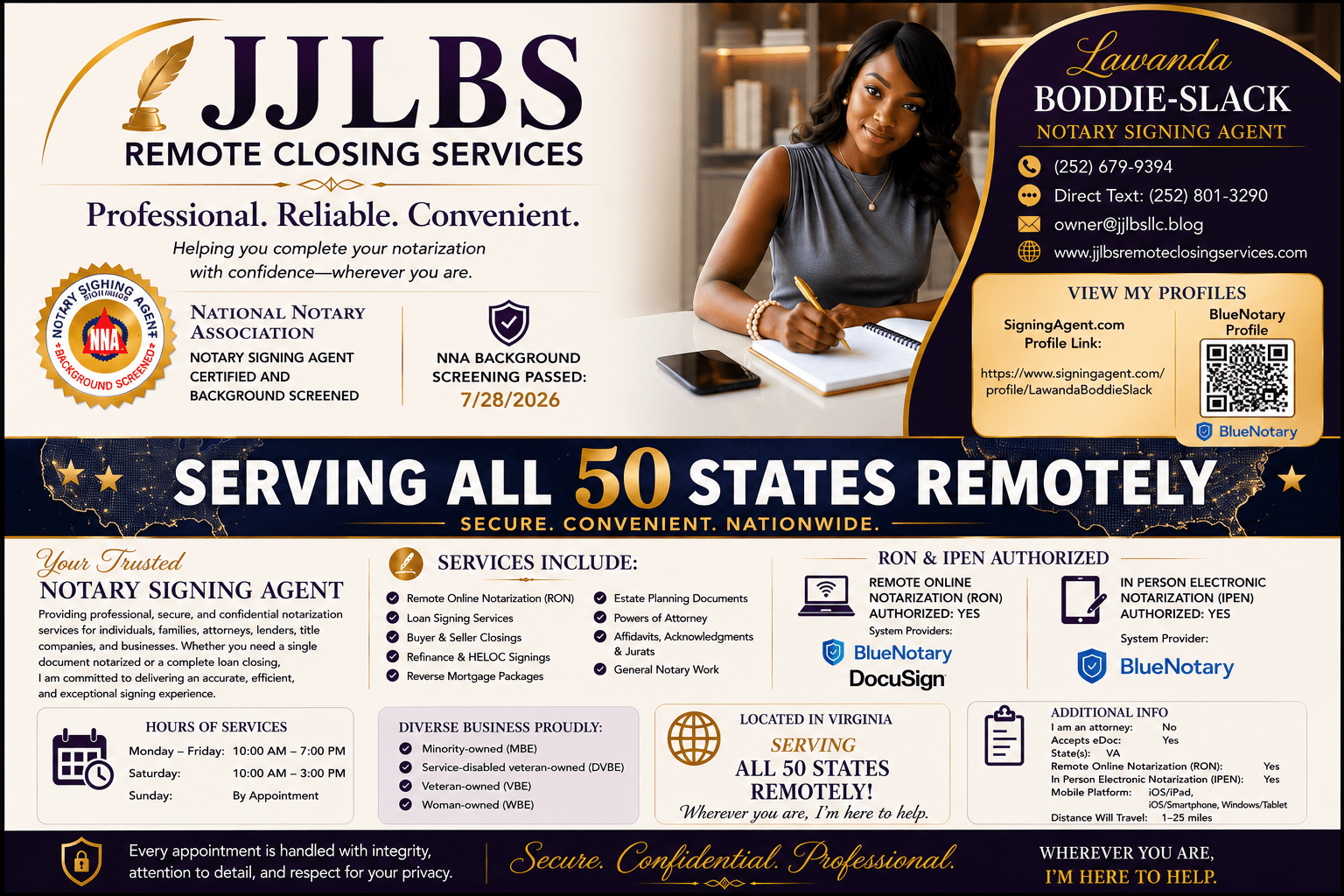
JJLBS Remote Closing Services is proudly owned and operated by Lawanda Boddie-Slack, a Virginia Traditional & Electronic Notary and Certified Notary Signing Agent dedicated to serving individuals, families, businesses, attorneys, lenders, title companies, and real estate professionals.
As a certified signing agent with a current background screening and authorization to perform both Remote Online Notarization (RON) and In-Person Electronic Notarization (IPEN), our goal is to provide a professional experience built on integrity, confidentiality, and attention to detail.
Technology has transformed nearly every aspect of our daily lives—including notarization.
Instead of rearranging your schedule to visit an office, qualifying documents can often be notarized remotely through a secure online platform. With a computer or smartphone, a reliable internet connection, and valid identification, many clients can complete their notarization without leaving home or the office.
Remote notarization offers several advantages:
For busy professionals, military families, business owners, and individuals with mobility or transportation challenges, remote notarization can be an efficient alternative to traditional in-person appointments.
Although many people associate Notary Signing Agents with mortgage closings, our services extend far beyond real estate transactions.
We regularly assist with:
Every appointment receives the same level of professionalism, regardless of the size or complexity of the transaction.
At JJLBS Remote Closing Services, every appointment is guided by three core principles:
Your documents deserve careful attention. We strive to ensure every notarization is completed accurately and efficiently while providing courteous, responsive service.
Your privacy matters. Sensitive personal and financial information is handled with the utmost care throughout the signing process.
We understand that life doesn’t always fit within traditional business hours. Our goal is to make scheduling easy and the signing process as seamless as possible.
Based in Virginia, JJLBS Remote Closing Services proudly offers Remote Online Notarization to clients throughout the United States where permitted by applicable law. This nationwide reach allows us to assist clients wherever they are, without compromising security or professionalism.
Our blog is designed to be a helpful resource for clients, homebuyers, real estate professionals, lenders, attorneys, and anyone who needs reliable notarial services.
In the coming weeks, we’ll cover topics such as:
Our goal is to answer common questions, share practical guidance, and help make every signing experience as smooth as possible.
We’re honored that you’ve taken the time to learn more about JJLBS Remote Closing Services. Whether you’re signing your first mortgage documents, updating your estate plan, or simply need a document notarized, we’re here to help with dependable, client-focused service.
We look forward to serving you.
JJLBS Remote Closing Services
Professional. Reliable. Convenient.
Serving All 50 States Remotely
Secure. Confidential. Professional.
Ready to schedule your appointment?
Visit our online scheduling page or contact us directly—we look forward to assisting you with your next notarization.
Have a WordPress.com account? Log in now.

